
Boxabl Driveway & Pavers in Fremont: A Homeowner’s Guide
A Boxabl Casita is a folding 361-square-foot home that unfolds on-site in about an hour, but the unit arrives on a trailer that needs a straight, level, load-bearing path of at least 10 feet clear from the street to the placement point. Most Fremont lots don’t have that path by default, and retrofitting one after the unit is ordered is where the budget goes sideways. If you’d rather plan this on paper with a contractor than figure it out under pressure, call (866) 797-6171 for a free estimate and a written access plan before you place your order.
What clearance does a Boxabl delivery actually need in Fremont?
The short answer: plan for a 10-foot minimum path width, 14 feet of overhead clearance, and a turning radius that lets a delivery trailer swing off Fremont’s residential streets without backing blind. Boxabl’s published specs name a minimum of 10 feet for the crate path, but in our experience the practical target is 12 feet to allow for the crane or telehandler that often does the final lift, plus 4 feet of working room on either side. Overhead clearance matters most in the older Fremont neighborhoods where mature street trees, low utility drops, and garage eave overhangs sit right where the path needs to run.
- Path width: 10 feet minimum, 12 feet comfortable, 14 feet if the unit needs to be lifted rather than rolled
- Overhead clearance: 14 feet clear from street to placement, including tree canopy, utility lines, and roofline overhangs
- Grade: under 3% side slope; a 2% cross-slope over 60 feet is where units start to slide on the crate
- Turning: a straight pull from the street is best; if a turn is unavoidable, plan the widest radius your lot will allow
- Ground bearing: compacted aggregate base capable of carrying a loaded delivery truck and trailer (often 15-plus tons)
Where this gets hard in Fremont is the 1950s and 1960s single-family stock in Irvington and Centerville, where side yards are commonly 5 to 6 feet. A path there isn’t a driveway extension; it’s a new access corridor. That’s the number to know before you sign the Boxabl order form, not after.
Can my existing Fremont driveway serve as the access path?
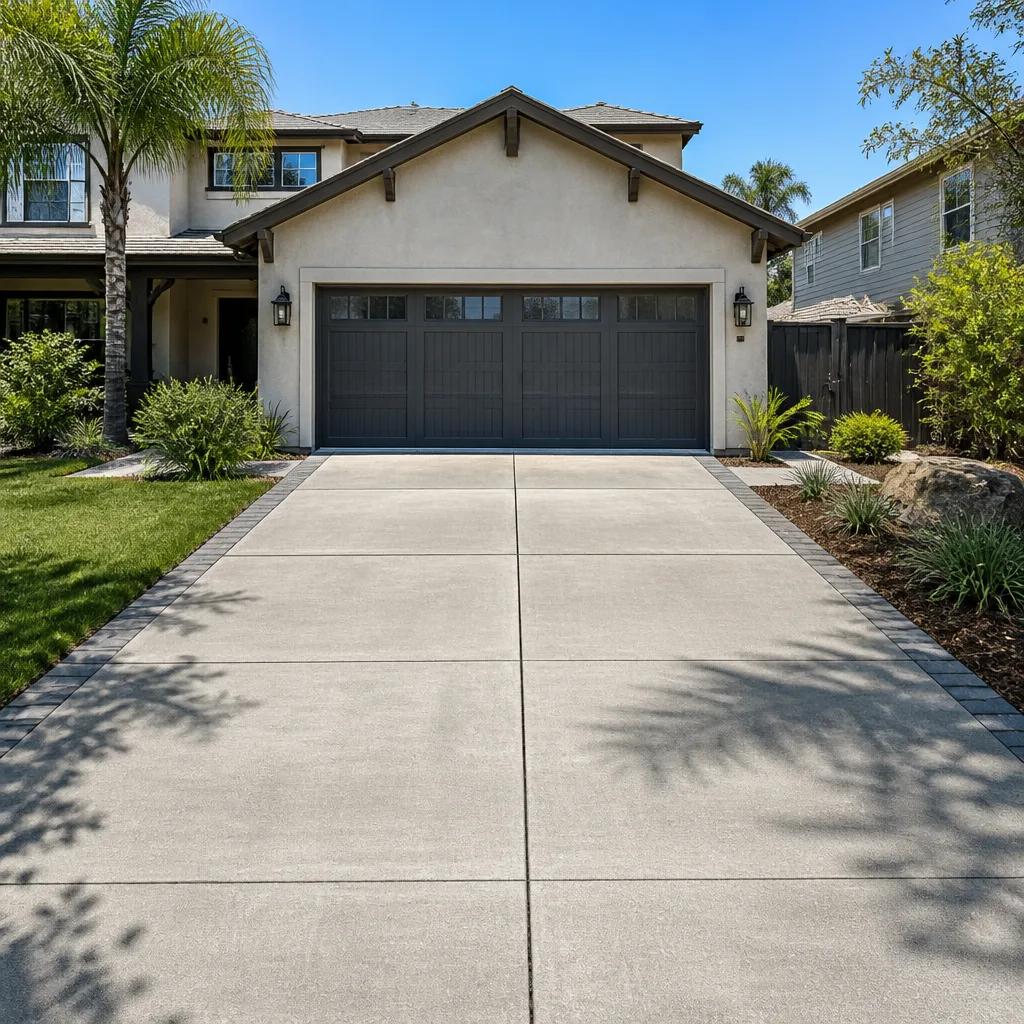
Sometimes yes, often no. An existing Fremont driveway works as the Boxabl access path only if it runs in a straight line to the placement point, has a base thick enough for a loaded trailer, and clears overhead obstructions to 14 feet. Most Fremont driveways are 16 to 20 feet long and 9 to 10 feet wide, which is wide enough on paper. The failure points are almost always the base thickness (many were poured at 3 to 4 inches over dirt with no compacted aggregate) and the turn from the driveway into the yard. We pulled a 4-inch slab off a driveway in Ardenwood last month where the concrete had cracked through at the apron because a car hauler had driven over it in 2019; a loaded Boxabl trailer would have punched through it.
Walk your own lot and check three things:
- Measure path width at the narrowest point, not the widest.
- Look for overhead clearance issues: tree limb, low wire, garage overhang, HVAC line set.
- Assess base thickness. If you don’t know it, a contractor can core a small hole in 20 minutes and tell you.
If any one of those fails, you’re planning a new path, not extending the old one.
Temporary gravel path vs. permanent pavers: what’s the cost difference in Fremont?
A temporary compacted gravel access path in Fremont runs $14 to $28 per square foot, while a permanent paver path with a properly compacted base runs $22 to $42 per square foot depending on material and base depth. For a 60-foot path at 12 feet wide (720 square feet), that’s roughly $10,000 to $20,000 for gravel versus $16,000 to $30,000 for pavers. The gravel is often the right call when the access path is temporary; the pavers are the right call when the same path becomes the finished residential driveway and you don’t want to tear out an interim surface later.
- Temporary compacted gravel: $14 – $28/sq ft installed, removable, 2- to 4-year service life, no wet utility risk
- Permanent pavers with base: $22 – $42/sq ft installed, 8-inch compacted Class II base, 20-plus year life
- Base prep only (owner finishes later): $8 – $15/sq ft, useful if you want the Boxabl in now and pavers next spring
- Driveway extension apron (permanent): $28 – $48/sq ft with wet-set or permeable joint, matching existing pavers
The honest math: gravel avoids $6,000 to $10,000 up front but costs that back plus removal if the same path needs to become a permanent driveway. If your Fremont lot will keep the path forever, pavers are the cheaper answer over a decade. Driveway & Pavers in Fremont goes deeper on product lines and base specs.
Does a Boxabl count as an ADU in Fremont, and does the access path need a permit?
In Fremont, a Boxabl Casita is treated as an accessory dwelling unit (ADU) or junior ADU (JADU) depending on square footage and whether it has a full kitchen and bath, and the access path triggers its own permitting question when it crosses a utility easement. A Casita is 361 square feet with a full bath and kitchenette, which places it in the ADU category under Fremont’s municipal code, not a “tiny house” or shed category. Setbacks for a detached ADU in Fremont are generally 4 feet from side and rear property lines, and the ADU can’t exceed 16 feet in height. The bigger trap for homeowners is the access path: if your proposed paver path crosses a recorded utility easement (PGA&E, water, or sewer lateral), the city will typically require a plot plan review and a revocable encroachment permit or an easement abandonment before a permanent hardscape can be placed over it.
What we see on the ground in Fremont subdivisions:
- Centerville and Irvington: 5- to 6-foot side yards, requiring a new corridor, easements common along the rear property line
- Ardenwood: wider lots, but rear easements are typical, so a rear-yard placement often hits the easement question
- Niles and Mission San Jose hills: grade and slope are the binding constraint, not width
- Warm Springs: newer lots with HOA review layered on top of city review
Plan on 3 to 6 months for the ADU permit itself in Fremont, plus a separate 4 to 8 weeks for an easement review if the path crosses one. Home Additions & ADU in Fremont covers the permit sequencing in more detail.
Which pavers handle a Boxabl delivery and still look like a finished driveway?
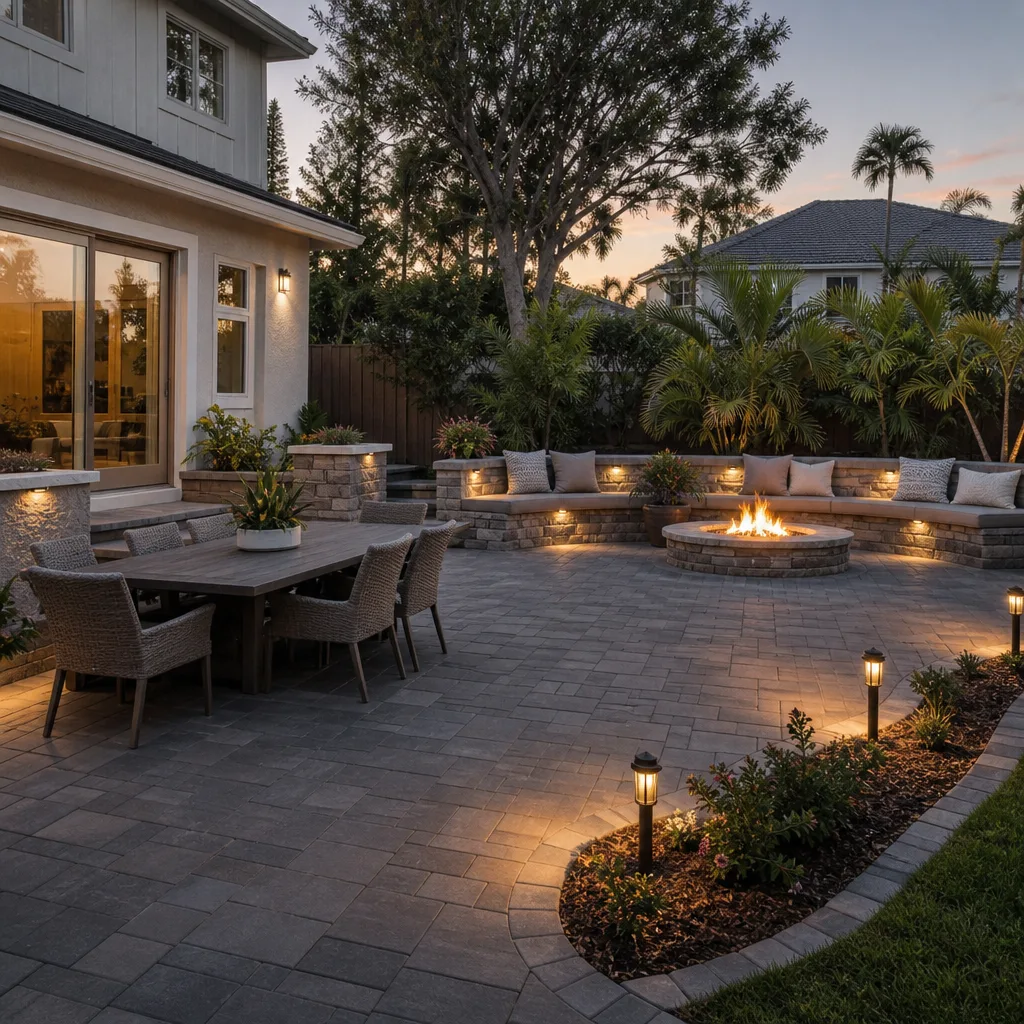
The pavers that work for a Boxabl access path are the same ones we specify for a residential driveway: a 60mm or 80mm interlocking concrete paver with an 8-inch compacted aggregate base and a geotextile separation layer, not a patio paver laid on sand. Two product lines we specify in Fremont regularly are Belgard’s Dimensions and Techo-Bloc’s Blu 60 series, both rated for vehicular traffic at the 60mm-plus thickness and both available in Fremont-appropriate color families (the warmer browns and grays that match the 1950s and 1960s stucco palette most of the city’s housing stock uses). For boxed deliveries where a loaded trailer will pass over the surface once and then never again, a compacted aggregate base of 8 inches topped with 1 to 2 inches of bedding sand is the minimum; 10 inches of base is what we recommend when the path will remain a residential driveway after delivery.
If the delivery is the only heavy load the path will ever see, a lower-cost option is a temporary 6-inch base with pavers laid dry-set, which saves $4 to $6 per square foot and still looks finished. The difference in spec matters: a 6-inch base is fine for a one-time 15-ton pass, an 8- to 10-inch base is what you want if a U-Haul, a pool contractor’s truck, or a second delivery will use the same path in five years. Also worth naming: drainage. A paver path that adds 720 square feet of impervious surface in Fremont triggers a drainage plan under the city’s stormwater requirements; permeable pavers with open-graded base avoid that review in most cases. For most Fremont lots we’re seeing permeable being the cheaper permitting path, not just the greener one. If you want to layer in matching fencing around the finished placement, Fence Installation in Fremont covers materials and permits.
Project sequencing: when to pour, when to pave, when to connect
The right order in Fremont is this: site survey and access plan first, permits pulled second, pad footings and utility trenching third, base installation and compaction fourth, Boxabl delivery fifth, paver surface and final connections last. Doing the pavers before the delivery is the single most common sequencing error we see. The delivery trailer and crane traffic will crack or rut any finished paver surface, and the surface has to be lifted and re-set, which adds $3,000 to $6,000 to a 720-square-foot path.
- Weeks 0 – 2: site survey, access plan, easement search. Confirm placement point, path corridor, and utility locations (call 811 before any digging).
- Weeks 2 – 8: ADU permit submitted; if an easement is crossed, easement review filed in parallel.
- Months 3 – 5: permit issued, footing and slab work done, utility trenching and conduit installed (electrical, water, sewer, and any gas if specified).
- Weeks 20 – 22: base installation and compaction, to finished grade minus paver thickness. Stop here.
- Week 23: Boxabl delivery and unfolding. The path is now a compacted base, which handles the trailer fine.
- Weeks 24 – 26: paver surface set, utility connections terminated and inspected, final grade and drainage work done.
Fremont’s plan check queue has run 4 to 8 weeks on ADU permits recently, with a second review cycle on roughly half of submittals, so budget 3 to 6 months from submittal to issuance on a Casita placement. The pavers themselves are a one- to two-week install once the base is compacted and the surface is reserved. Roof and exterior envelope work around the placed unit (if any) happens after the unit is set, using Rowan Construction Group Fremont trades, and we’d specify CertainTeed or Owens Corning shingles if the surrounding home needs a re-roof at the same time.
When to call a pro
If your Fremont lot fails any of the three base tests, or if a proposed path crosses a recorded easement, or if the path requires more than a 0.5% grade correction, bring in a contractor for the access plan before you place the Boxabl order. We see too many homeowners order the unit first and then learn the path needs a 40-foot segment of new base plus a paver surface plus an easement review, and the schedule slips a full season. If you already have a written estimate from another contractor, we’ll review it line by line at no charge as a Free Second Opinion – a standing offer, not a sales tool. Related services in Fremont we handle on the same access project: driveway paving, fencing around the placement, and any ADU permit coordination.
The Bottom Line
The Boxabl Casita’s folding format is the selling point, but the access path is the project. Before you order the unit: confirm 10 to 12 feet of clear path width, 14 feet of overhead clearance, and a base that carries a loaded trailer (8 to 10 inches of compacted aggregate under any paver surface). Price the path in real dollars – $14 – $28 per square foot for temporary gravel, $22 – $42 for permanent pavers – and treat the easement question as a permitting gate, not a footnote. Fremont ADU permits run 3 to 6 months. Every Rowan quote on a project like this is a flat written price with a written scope before any work starts, and no change proceeds without a signed change order; that’s Clause 1 of The Haven Standard, and it’s the reason we can tell you what a path will cost before your Boxabl ships. If you’re in Fremont and need help, Rowan Construction Group Fremont offers free estimates – call (866) 797-6171.
Frequently Asked Questions
Plan for 10 feet minimum and 12 feet comfortable; 14 feet if the unit will be lifted rather than rolled into place. The 10-foot figure is the crate width; the extra 2 to 4 feet accounts for the trailer, the crane or telehandler outriggers, and working room. If your Fremont side yard is under 10 feet, the path is a new access corridor and needs a contractor’s access plan before you order the unit. Call (866) 797-6171 for an exact quote – estimates are free.
Sometimes. Existing Fremont driveways are usually wide enough but often not thick enough or clear enough overhead. Have the base cored and check the 14-foot overhead clearance before assuming the driveway works. If it passes both tests, you may not need pavers for the delivery itself; if it doesn’t, a temporary gravel path at $14 – $28 per square foot is the budget answer. Call (866) 797-6171 for an exact quote – estimates are free.
Yes. A 361-square-foot Casita with a full bath and kitchen is treated as a detached ADU under Fremont’s municipal code, with a 4-foot side and rear setback and a 16-foot height limit on most lots. Plan 3 to 6 months for the permit; if the access path crosses a recorded utility easement, add 4 to 8 weeks for the easement review. Call (866) 797-6171 for an exact quote – estimates are free.
Not under our terms. Rowan writes the flat price and the scope before any work starts, and no work proceeds on a change until a change order is signed. If a boulder or unmapped utility line turns up mid-excavation, that’s a conversation with a document, not a surprise invoice. Call (866) 797-6171 for an exact quote – estimates are free.
Written by the team at Rowan Construction Group Fremont.
Need Construction Help?
Call Rowan Construction Group Fremont - licensed & insured, here with fast after-hours help in Fremont.
(866) 797-6171